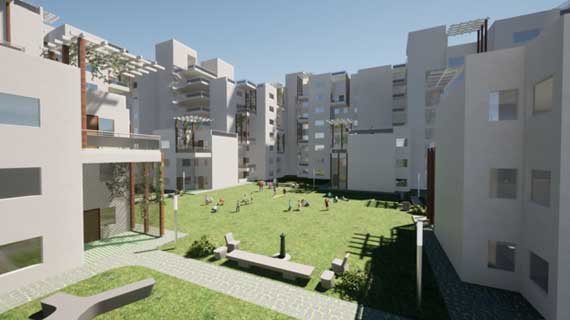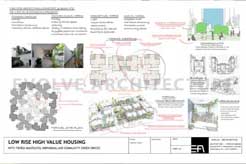
Low Rise High Value Housing is developed as a series of housing prototypes for the urban poor, conceived in alignment with the Housing for All initiative and Sustainable Development Goal 11 – Sustainable Cities and Communities. The project demonstrates how dignified, climate-responsive living environments can be achieved within limited resources while maintaining social equity and spatial quality. A residential density of approximately 250 persons is achieved on a 3.28-acre site through a carefully planned ground-plus-four low-rise configuration, balancing efficiency with human scale.
.jpg)
.jpg)
.jpg)
The planning strategy responds sensitively to social, cultural, and climatic contexts, ensuring inclusivity, safety, and comfort across diverse user groups. Dwelling units are organised around a hierarchy of tiered, usable green terraces that transition from private spaces to semi-public shared areas and larger public community courts. This gradation allows for individual privacy while encouraging collective living, informal interactions, and community ownership of shared spaces.
.jpg)
The planning strategy responds sensitively to social,
cultural, and climatic contexts, ensuring inclusivity,
safety, and comfort across diverse user groups. Dwelling
units are organised around a hierarchy of tiered, usable
green terraces that transition from private spaces to
semi-public shared areas and larger public community courts.
This gradation allows for individual privacy while
encouraging collective living, informal interactions, and
community ownership of shared spaces.
.jpg)
Staggered built heights and articulated massing improve natural light, cross-ventilation, and visual permeability, enhancing physical and perceptual comfort. Vehicular circulation is restricted to the site periphery, enabling a pedestrian-oriented internal network that supports children, the elderly, and everyday social life. Architectural elements such as verandahs, bridges, and community terraces act as transitional buffers between private and public realms, facilitating both active and passive social engagement.
.jpg)
.jpg)
The project integrates physical comfort, psychological well-being, and social cohesion through climate-responsive design, noise control, clear territorial definition, and visual connectivity. Overall, the proposal illustrates a scalable, low-rise housing model that delivers high spatial value, strengthens community bonds, and contributes meaningfully to sustainable urban living for economically vulnerable populations..
.jpg)