
The DFCCIL Office building completed in 2013 in Ambala is conceived
as a contemporary institutional facility that reflects efficiency,
transparency, and structural clarity—values intrinsic to the Dedicated
Freight Corridor Corporation of India. The architecture adopts a bold
yet restrained expression, combining solid massing with lightweight
elements to create a strong urban presence.
The
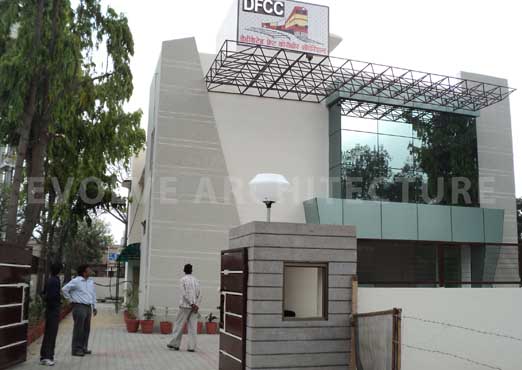
building is organized as a compact, functional volume with a clear
hierarchy of spaces. A prominent glazed façade anchors the front
elevation, allowing ample daylight into the office interiors while
visually expressing openness and accessibility. This transparent core is
framed by inclined solid walls that add dynamism, structural stability,
and a sense of monumentality to the otherwise compact footprint.
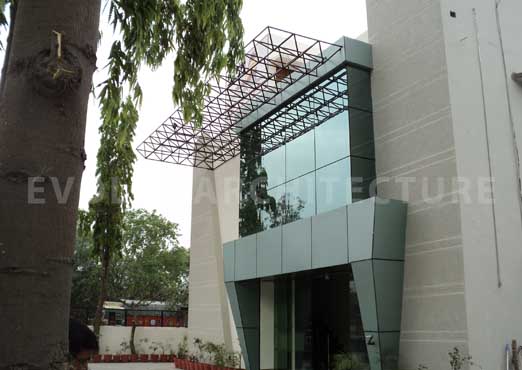
A cantilevered steel lattice canopy crowns the façade,
acting as both a climatic device and an architectural statement. It
provides shading, reduces heat gain, and reinforces the industrial
character associated with rail infrastructure. The lower levels are
articulated with metal cladding panels, creating a robust base and a
visual transition between public and secure zones.
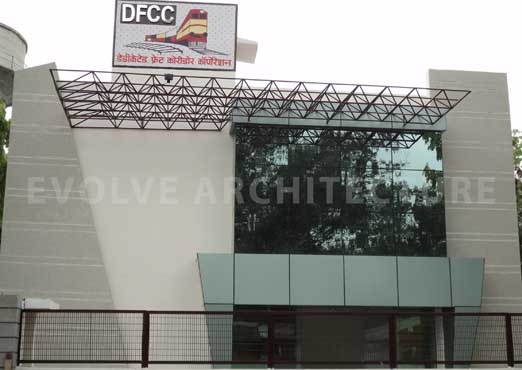
Landscape elements and peripheral planting soften the built form and
guide movement towards the entrance. Overall, the DFCCIL Office balances
functionality, identity, and contemporary design, presenting an
efficient workplace while establishing a distinctive institutional image
within its urban context.
A cantilevered steel lattice canopy crowns the façade,
acting as both a climatic device and an architectural statement. It
provides shading, reduces heat gain, and reinforces the industrial
character associated with rail infrastructure. The lower levels are
articulated with metal cladding panels, creating a robust base and a
visual transition between public and secure zones.
Landscape elements and peripheral planting soften the built form and
guide movement towards the entrance. Overall, the DFCCIL Office balances
functionality, identity, and contemporary design, presenting an
efficient workplace while establishing a distinctive institutional image
within its urban context.
Landscape elements and peripheral planting soften the built form and
guide movement towards the entrance. Overall, the DFCCIL Office balances
functionality, identity, and contemporary design, presenting an
efficient workplace while establishing a distinctive institutional image
within its urban context.