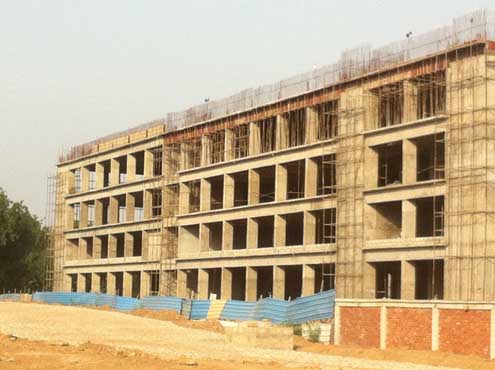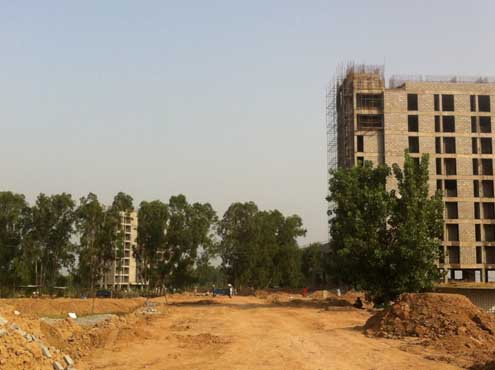
The National Agri-Food Biotechnology Institute (NABI), Mohali, is envisioned as a contemporary research campus set within a structured and ecologically responsive green landscape of 50 acres. The architectural approach emphasizes clarity, functionality, and long-term durability, aligning with the institute’s mandate of advanced scientific research and innovation. The campus accommodates state-of-the-art laboratories, academic and training facilities, administrative offices, shared institutional spaces, research fields and also residential areas, all planned to support efficient workflows and interdisciplinary collaboration.
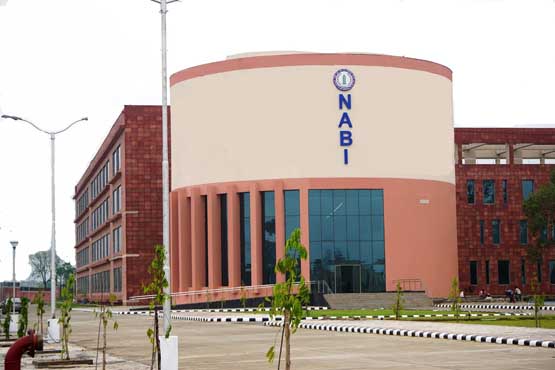
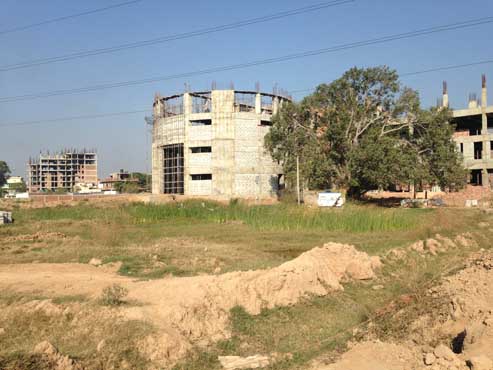
The master plan organizes the campus into distinct yet interconnected building clusters, allowing clear functional zoning while promoting interaction among researchers, students, and faculty. Landscaped lawns, shaded courts, and green buffers act as transitional spaces between buildings, improving microclimate, visual comfort, and informal gathering opportunities. Pedestrian-friendly pathways are clearly separated from service and vehicular circulation, ensuring safety, legibility, and operational efficiency across the site.
.jpg)
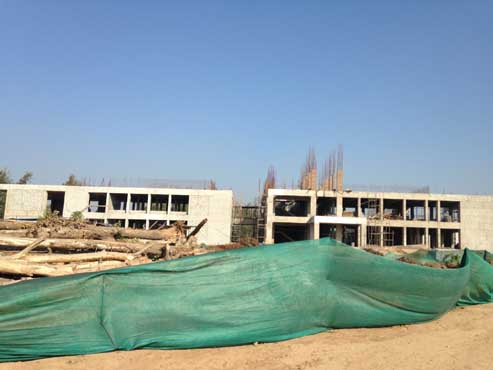
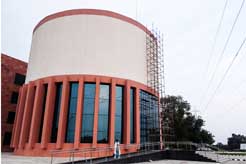
Architecturally, the built form balances a strong institutional identity with human-scaled spaces, avoiding monumentality in favor of disciplined, contextually grounded design. Planning, material selection, and execution were consciously aligned to meet sustainability benchmarks and achieve a 3-star GRIHA rating. Overall, the NABI campus reflects values of scientific rigor, collaboration, and national importance, creating an environment that supports research excellence while maintaining a strong relationship between architecture, landscape, and purpose.